Guide · August 2026
How Dealers Buy Cars on Facebook Marketplace Without Wasting Hours (2026 Guide)
Dealers buy cars on Facebook Marketplace by doing five things consistently: monitoring listings continuously instead of scrolling, filtering out dealer posts and salvage titles, valuing every car against wholesale data before contact, messaging the seller within minutes, and negotiating inside a preset price cap. Here is the working process, step by step.
Around 47 fresh private-party cars can hit a single dealer's buy box in one morning — and the good ones are gone by the afternoon. This guide walks through the process the winning stores run, step by step, and where software fits into each one.
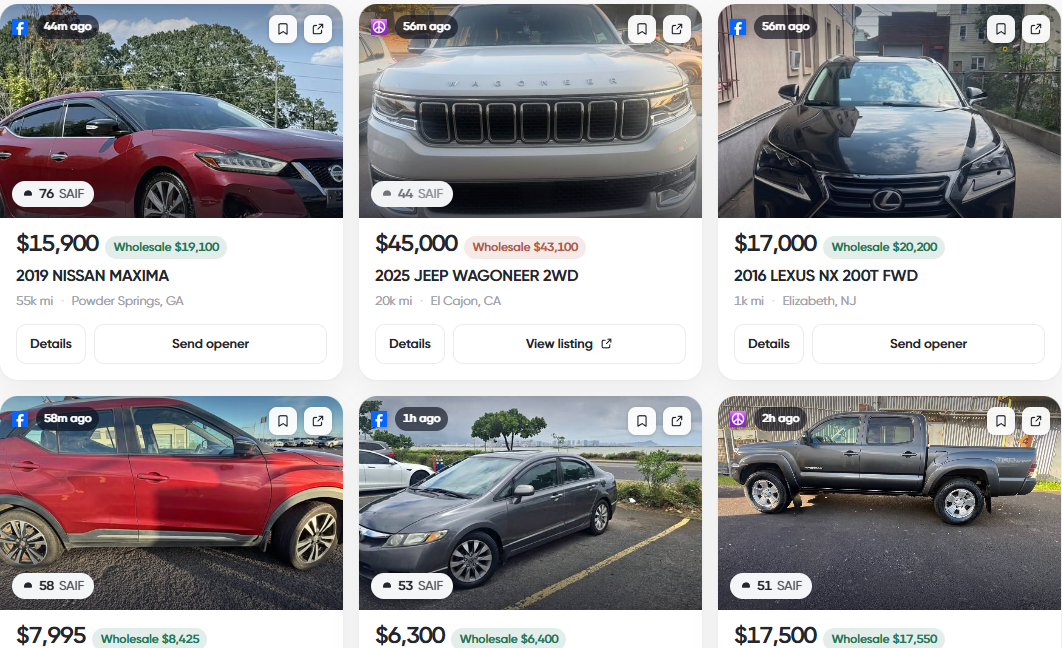
Why does private-party sourcing matter now?
Because the math moved. Private sellers grew from 28.6% of U.S. used-vehicle sales in 2015 to 36.9% by 2022, on a trajectory toward roughly 40% (NADA figures, via industry reporting) — while lease returns thinned and auction lanes got more expensive, with fees and transport stacking onto every hammer price. BCG-reported survey data has put inventory shortage at the top of most dealers' problem lists. The inventory dealers say they cannot find is increasingly sitting in driveways, posted on Facebook Marketplace — the largest private-seller channel — plus OfferUp, Craigslist, and regional boards.
How do you find listings before other dealers do?
Speed is the whole game. A fairly priced private car attracts several buyers the same day it posts, and sellers overwhelmingly deal with whoever reaches them first with something concrete. A dealer who responds inside the first 15–20 minutes converts at several times the rate of one who replies that evening.
Manual scrolling cannot keep that pace. Marketplace's saved searches are consumer-grade — no reliable instant alerts, no cross-market view, and nothing to tell you a listing is fresh versus recycled. Stores doing this by hand assign someone to refresh searches across model lines several times a day, and they are still late to every car that posted in between. Continuous-monitoring platforms exist precisely for this gap: AutoReveals, for example, lands new Marketplace listings in a dealer's feed a median of about 15 minutes after posting, across every market you buy in at once.
How do you filter out the noise?
Most of what posts is not buyable, and the discipline is refusing to spend minutes on it. Four filters do the work:
Dealer posts disguised as private sellers. The tells: one “owner” with a dozen active listings, plate frames from a store, stock photos, odd trade-in language. Salvage and rebuilt titles. Sellers rarely volunteer them; the price being 25% under market is usually the flag. Duplicate cross-posts. The same car on Marketplace, OfferUp, and Craigslist at three prices — you want one record, at the lowest ask, not three chases. Pricing outliers. Too far under market signals title or condition problems more often than a deal.
Each of these can be checked by hand, and the checklist above is how to do it. AI filtering automates all four before a listing ever reaches a buyer's queue — which is less about saving effort than about protecting response time for the cars that deserve it.
How do you value a car before contacting the seller?
The offer that wins is anchored before the conversation starts. The sequence: get the VIN — and when the listing hides it, resolve it from the license plate visible in the photos, which modern platforms do automatically. Then price the exact car — year, make, model, mileage, your market — against live wholesale transaction data, not a retail book value: you are buying at wholesale, so what identical cars actually sold for is the number that protects your margin. Then check title and lien status before investing a drive. A buyer who opens with “I can be at $8,400 based on what these are actually bringing at wholesale” reads as a professional, not a lowballer — and that credibility carries the whole negotiation.
How do you message sellers at scale without getting flagged?
Here is the part most guides gloss over, and should not. Marketplace listings do not expose phone numbers. Contact happens in Messenger, and Meta restricts high-volume messaging from personal accounts — a personal profile blasting dozens of copy-paste openers is exactly the pattern its systems act on. Losing an account mid-negotiation costs more than every hour the automation saved.
So the honest playbook has two lanes. On Marketplace itself, message like a person: reference the actual car, ask one concrete question, identify your store honestly — and use purpose-built acquisition platforms, whose messaging infrastructure is designed for dealer workflows, rather than improvising volume through a personal profile. For sources that do expose phone numbers, like Craigslist, registered business texting (10DLC) is the compliant channel built for exactly this: a registered sender, honest identification, and opt-out handling.
How do you negotiate — and keep the guardrails on?
Scale without discipline just buys mistakes faster. The structure that works: define a buy box (segments, years, mileage, price bands) so buyers chase decisions, not inventory; set a hard maximum per car, anchored to the wholesale number, before the first message; respect quiet hours — a 6 a.m. offer reads as a scammer even when it is not; and keep approval authority with the manager, so no individual conversation can outrun the plan.
This structure is also what makes AI negotiation safe to use. An agent like AutoReveals' Saif AI works the seller inside exactly those dealer-set caps — it opens, answers questions, and moves the price, but it cannot exceed the ceiling, it observes quiet hours, and the dealer approves every offer, with the team able to take over any thread. The guardrails are not a limitation on the automation; they are why it can be trusted with the conversation at all.
How do you make it a repeatable process?
One good month is luck; a buy center is a system. Assign named buyers to the channel with real time carved out — private-party sourcing dies as a side task. Track the pipeline by stage — contacted, negotiating, appointment, bought — so follow-up is scheduled instead of remembered; most private deals die from silence, not rejection. And measure cost per acquired unit — software, hours, and misses included — against what the same car costs through the lane after fees and transport. That number is how the channel earns its budget, and in most markets it is not close.
Go deeper: how to build a private-party buy center · the tools that monitor Marketplace, compared · why wholesale transaction data beats book values for buy decisions.
Frequently asked questions
What is the best tool to find cars on Facebook Marketplace as a dealer?
Purpose-built acquisition platforms — AutoReveals, VETTX, and VAN all monitor Marketplace for dealers. The differences that matter: how fast a fresh listing reaches you, whether the car arrives already valued against wholesale data, and whether outreach is handled by your team or automated with dealer-set guardrails.
Can dealers message Facebook Marketplace sellers automatically?
Marketplace listings expose no phone numbers — contact happens through Messenger, and Meta restricts high-volume messaging from personal accounts. That is why dealers use purpose-built platforms with compliant messaging infrastructure instead of blasting from a personal profile, and reserve registered business texting (10DLC) for sources that do list phone numbers.
How do dealers avoid salvage titles and fake private sellers on Marketplace?
Watch for the tells: a “private” seller with many active listings, stock-photo galleries, prices far under market, and vague title answers. Decode the VIN — or resolve it from the license plate in the photos — and run title and lien checks before spending time. Acquisition platforms automate this screening in-feed.
How fast do dealers need to respond to a private-party listing?
Within minutes, not hours. A well-priced private car draws several buyers the same day, and the dealer who reaches the seller first usually gets the appointment. Practically, that means continuous monitoring with instant alerts — a manual check a few times a day is structurally late to every good car.
See it on live data for your market — a 15-minute demo, no setup.
Book a 15-minute demo